

Full and Partial Dentures in Erie, PA

Healthy mouth structure allows us the ability to smile, chew foods comfortably, and speak clearly. When extensive tooth loss begins to affect these abilities, our quality of life can suffer significantly. Dentures comprise a full or partial set of artificial teeth that help restore these critical functions. They are constructed from a durable hard resin material, and custom-fitted and fabricated to your mouth to achieve the most natural look and feel possible.

elderly couple smiling

Types of dentures

Depending on the extent of tooth loss and patient preference, there are several types of dentures you might be fitted with. 

Full vs. partial dentures

Full dentures replace an entire row of missing teeth along the top and/or bottom gumline and are held in place by suction or with the aid of an oral adhesive.

Partial dentures are used in situations when one or more teeth along a particular gumline are salvageable and are designed to fit around the remaining natural teeth. 

Permanent vs. immediate dentures

Permanent dentures are intended to be a long-term replacement for missing teeth, with a lifespan of five or more years. 

Immediate dentures are fabricated just prior to dental surgery, filling in for the extracted teeth until the mouth is healed enough for accurately fitting permanent dentures. You may need to be refitted for new sets of immediate dentures as swelling in the mouth subsides.

Tooth-supported vs. implant-supported overdentures

For many patients, overdentures present a more comfortable alternative to traditional dentures. Like traditional full or partial dentures, they’re fully removable, but a built-in attachment system negates the need for an oral adhesive. They’re classified by whether they fit over modified natural tooth structures (pulp and crowns removed, but roots preserved) or dental implants (with titanium posts anchored into the jawbone serving as the roots). 

Fitting for dentures

Getting fit for your new set of permanent dentures consists of four steps:

  1. We’ll take a series of impressions to better understand the mechanics of your jaw structure and bite.
  2. From the impressions, we will create a prototype of the denture that we will test for accurate color, shape, and fit. 
  3. Your permanent dentures will be fabricated in a lab.
  4. Minor adjustments and tweaks as necessary.

Restore your smile with Sleep Dentistry

Tooth loss is no fun for anyone, but it should by no means represent an end to enjoying some of life’s most fundamental pleasures — sharing a warm smile, a good story, or a delicious meal. Visit Sleep Dentistry in Erie, PA for dentures or any dental restoration need, and the peace of mind that your comfort, peace of mind, and dignity are our top priorities.

SCHEDULE AN APPOINTMENT

Frequently Asked Questions

What is the average cost of a full set of dentures in Pennsylvania?

The cost of dentures in Pennsylvania can vary widely, depending on the type of denture, the material they’re constructed from, and the amount of customization. The average cost for a full set of mid-range dentures is about $1,800 — this price point will usually get you something that looks natural and of solid quality. Keep in mind that tooth extractions and other dental procedures to prepare the mouth for the dentures may represent additional costs. 

Does Medicare cover dentures?

No, Medicare does not cover the cost of dentures — nor does it cover the cost of most dental appliances. However, many dental insurance plans will cover at least a portion of the cost. Sleep Dentistry in Erie, PA also offers financial assistance, including monthly payment plans, to help you realize the benefits of your new set of dentures without paying the full cost upfront.

How do you clean dentures?

To clean your dentures:

  1. Run the appliance under water to release any trapped food particles
  2. Using a denture brush or an extra soft-bristled toothbrush, clean with water, denture paste, or a toothpaste free of abrasives (these will wear away at the denture material faster). 
  3. Soak dentures in a denture cleaning solution overnight, or use a rapidly acting cleanser and store in water. 
Can you eat with dentures?

You can eat and enjoy most foods after adjusting to your first few weeks in dentures, although you’ll want to exercise caution with hard, crunchy, chewy, or sticky foods. Starting out, we recommend soft foods like mashed potatoes, oatmeal, applesauce, eggs, yogurt, etc. Test heated foods before consuming — dentures do not have the nerve endings and temperature feedback capacities of natural teeth, and we do not want you to burn your mouth or tongue!

Can you sleep with dentures?

You can sleep with dentures, but you shouldn’t sleep with dentures for several reasons:

  1. Holding them in place puts a lot of pressure on the gums and underlying bone structure, and may negatively affect the shape of the mouth and in turn the fit of the appliance.
  2. Dentures provide ideal overnight accommodations for bacteria growth, which can irritate and inflame the gums leading to gum disease. 
  3. Dentures left in the mouth overnight can obstruct normal salivary flow, drying out the mouth and increased risk of developing oral thrush, a type of yeast infection of the gums and other soft tissues.
What is the cost of full dentures with extractions?

The cost of full dentures with extractions varies widely, typically ranging from $2,000 to $8,000 or more.

Basic dentures cost $600 to $1,500, mid-range $1,500 to $3,000, and premium options over $3,000. Extractions add $75 to $650 per tooth. Insurance may cover some costs, especially for extractions. Check with your provider or schedule an appointment with Dr. Mahoney for a personalized estimate. Payment plans and financing options are also available!

Where To Find Us 

📍 Address: 3915 Caughey Rd, Erie, PA 16506
 
📞 Phone:  (814) 833-3505
 

Recent Posts

Dental X-Rays: Why Are They Important

Posted on August 22nd, 2022 at 8:32 AM
Dental X-Rays: Why Are They Important

What is a Dental X-Ray?

The phrase dental x-ray describes a medical procedure where an oral health professional uses a device to scan the bone structure of a patient’s mouth.  They accomplish this one of two ways, either extraoral or intraoral. The former makes use of an x-ray machine situated outside of the patient’s mouth. If intraoral, a device is operated from inside the mouth.

After an x-ray is taken, the image is scanned to ensure that the bone structure is normal and healthy. In other cases, dental x-rays help identify a range of problems from fractured teeth to gum disease. Once a doctor is made aware of a particular issue, they can begin the treatment process.

Over time, dental x-rays also provide a history of the patient’s bone structure which helps monitor patient health through the years.

Patients have the option of visiting the dentist only for x-rays, but most undergo the procedure along with a routine check-up. The difference: routine check-ups happen every 6 months, while dental x-rays typically occur once a year.

In most cases, intraoral dental x-rays cost between $25-$300, depending on the number of x-rays and type. Regarding extraoral dental x-rays, the range is between $100-$750. Most insurances cover routine dental x-rays and check-ups.

Who Benefits from Dental X-Rays?

While everyone can benefit from dental x-rays, those who benefit most will naturally be people who more often engage their mouths besides talking and eating. Athletes are one example because they engage in activities that could potentially break bones, including the bones in their mouths. Other examples include police officers who engage in physical altercations and stunt actors. Added risk means a greater chance of damage.

Another group that benefits from dental x-rays is older adults and people who received dental work in the past. Anyone with past dental complications is more likely to face future problems. The dental x-ray helps the patient and doctor check the condition of prior solutions such as fillings and crowns.

Even if you have not received dental work in the past, dental x-rays are still crucial. All that’s needed is for one issue to go undetected for your health to pay the cost.

Though most patients receive an x-ray once a year, the frequency should depend on whether or not you fall into a higher-risk category.

Types of Dental X-Rays

Of the several types of dental-x rays performed across the country, most are intraoral. Here are four types of intraoral dental x-rays.

Panoramic

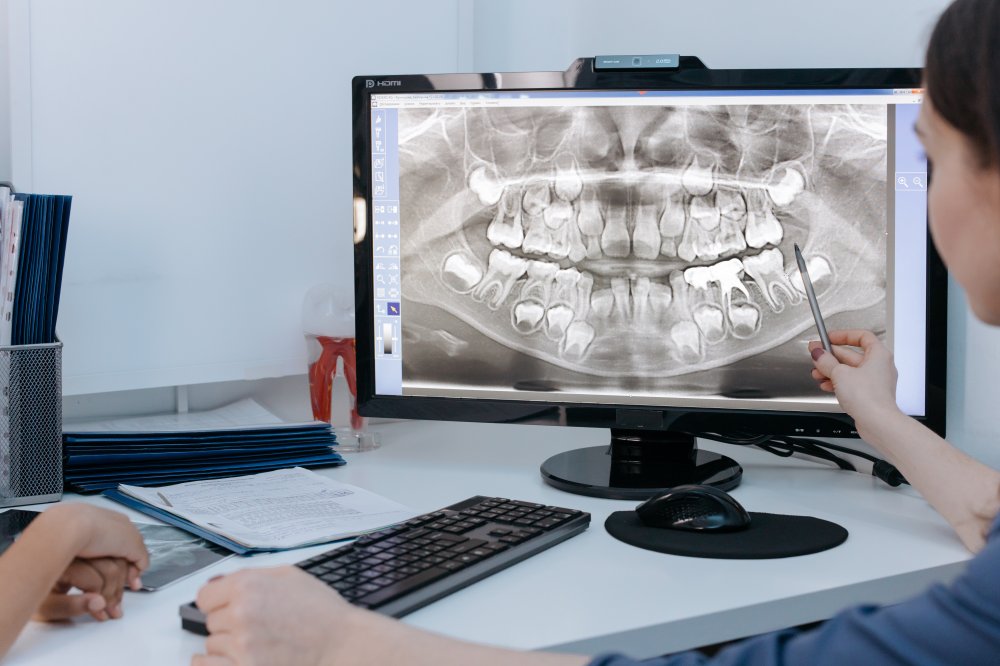
Panoramic (full-view) dental x-rays show the entire structure of a patient’s mouth in one image.

Bitewing

Bitewing dental x-rays earn their name because the dentist inserts a piece into the patient’s mouth on which they bite down. This type of x-ray only reveals a specific location but helps with finding issues between teeth. Often, the professional will have the patient bite down in multiple different areas for varying images.

Occlusal

The occlusal x-rays are used to track the development of an entire section of teeth on either the lower or upper jaw. These help with spotting impacted teeth, tumors, and other abnormalities.

Periapical

A periapical x-ray is used for studying a single tooth, from the surface down to the root.

Benefits of Dental X-Rays

Here are 3 immediate benefits of dental x-rays.

Identify health concerns

The more you know about what’s going on inside your mouth, the better your decision-making when planning your occupation, what toothpaste you use, mouthwash, and more. The more you’re aware of your health, the more peace of mind you’ll ultimately get.

Tracking wisdom teeth

Dental x-rays help track past dental work that has been performed but are also great for planning future dental work. Most people will develop wisdom teeth and dental x-rays help patients track the tooth’s development process.

Informs health professionals

In addition to the health decisions you make for yourself, most people also rely on guidance from their dentist. The more they know about the well-being of your teeth, the better their guidance. Sometimes dentists recommend different techniques or products depending on your health.

Do Dental X-Rays Show Cancers?

Dental x-rays can be used to identify cancers because the x-rays reveal growths and abnormal developments within the mouth.

Are Dental X-Rays Safe?

Dental x-rays are largely safe, but there is an inherent risk in the procedure. The x-ray would be impossible without some degree of radiation being used for scanning. However, there are federal and state restrictions in place to limit radiation exposure, and dental offices also use lead-lined gowns on patients for protection.

Contraindications to Dental X-Rays

  • Pregnancy

We know that visiting the dentist is not on everyone’s bucket list, but we here at Sleep Dentistry value the oral health of you and your family. Take a chance with us today and find out more about our services.

Schedule an Appointment