


Teeth Cleaning For Adults and Children in Erie, PA

While the foundation of dental hygiene is your at-home dental care routine, it's just as important to visit the dentist regularly to make sure your teeth are healthy and your smile is bright. Regular teeth cleaning performed by a professional dental hygienist prevents gum disease and tooth decay - which could ultimately lead to the removal of the tooth.

smiling couple

Why Have Professional Teeth Cleaning?

There are several good reasons why you should schedule teeth cleaning every six months, even if you maintain a meticulous dental hygiene regimen at home. 

  1. Dentists and dental hygienists have the tools and expertise to monitor for issues you might not necessarily be able to see or feel.

  2. Professional teeth cleaning instruments are the only thing powerful enough to remove hardened dental plaque, aka calculus or tartar. 

  3. Professional teeth cleaning can make your smile appear whiter and brighter, helping to remove stains, plaque, and tartar. 

  4. It can save you time, money, and suffering down the road — teeth cleanings prevent small problems from becoming major issues, sparing you time in the dentist’s chair undergoing costly procedures.

Teeth Cleaning Procedures

It’s important to set kids up for optimal oral health throughout their growth and development, which is a primary focus of pediatric dentistry and aided by regular teeth cleanings. As we get older as adults, we must treat our teeth with extra special attention and care so that we can enjoy life to the fullest. 

A typical teeth cleaning takes 30-60 minutes and consists of: 

  • Oral health exam (may include x-rays)
  • Removal of tartar and plaque buildup
  • Teeth polishing

Dental anesthesia is also available to patients who have a fear of dentists or simply need extra relaxation during procedures. At Sleep Dentistry Erie, we are committed to helping our patients — with or without insurance — achieve their healthiest smiles.

Schedule Appointment

Frequently Asked Questions

How frequently should I have my teeth cleaned?

You should have your teeth cleaned at least once a year for healthy adults, although a routine dental cleaning and examination every six months is preferable. If you have a chronic medical condition (such as diabetes), take medication (especially those that contribute to xerostomia, or dry mouth), wear braces, are prone to poor dietary (sugary or high-carb snacks between meals) or lifestyle habits (smoking), or simply have a mouth that is smaller and more difficult to clean, it is recommended you get checked up on more regularly.

Should I still get my teeth professionally cleaned even if I regularly brush and floss at home?

Yes, you should still get your teeth professionally cleaned. Even with regular brushing and flossing — and good technique with both — the vast majority of people fail to clear away all the plaque that builds up on and between teeth. Once that hardens into dental calculus or tartar, no amount of brushing or flossing can remove it. Only the specialized tools and equipment of a dental hygienist can loosen, rinse, and suction it away.

Why are my teeth so sensitive after a teeth cleaning?

One reason your teeth are so sensitive after a teeth cleaning is dental cleaning tools making contact with gum surfaces, especially puffy or swollen gums, leading to sensitivity or bleeding. Once teeth have been properly scaled of calculus/tartar, tooth structure that may have not been exposed in “many moons” will be experiencing sensation directly for the first time in a while, it will need time to adjust. Exposed tooth roots near the gumline are especially susceptible to sensitivity. 

How soon can I eat and drink again after having my teeth cleaned?

You can eat and drink immediately after having your teeth cleaned, unless you’ve received a fluoride treatment, which needs at least half an hour to settle and seal around your teeth to maximize its enamel-fortifying benefits. Nonetheless, take care with what you eat or drink after a professional dental cleaning, as your teeth will likely be sensitive to hot, cold, spicy, crunchy, or acidic foods. If you’re thirsty, drink water. If you’re hungry, opt for soft foods served near room temperature.

Will routine dental cleanings whiten my teeth?

Whiter teeth are an ancillary benefit of a routine dental cleaning, but not its goal — for that you may want to invest in our Lifetime Whitening Program.  Nonetheless, after we’re done buffering away tartar (which may take on a yellowish or greenish tinge) and polishing your teeth, they may very well look whiter and brighter than when you walked in!

Where To Find Us 

📍 Address: 3915 Caughey Rd, Erie, PA 16506
 
📞 Phone:  (814) 833-3505
 

Recent Posts

Dental Bridge vs Dental Implant: Which is the best solution for you?

Posted on December 9th, 2019 at 9:09 AM
Dental Bridge vs Dental Implant: Which is the best solution for you?

It’s everyone’s goal to make it through life with a fully intact, healthy smile. Unfortunately, due to physical trauma or periodontal disease, many people lose teeth permanently. Missing teeth don't just affect the look of your smile — they may also impact the ability to properly chew food or speak clearly. If left uncorrected, they may even lead to bone recession and loss in the jaw, ultimately changing the shape and structure of the face.

Clearly, losing one’s adult (permanent) teeth can have pretty serious implications! Thankfully, today’s dental professionals have more and more advanced ways of filling in the gaps with durable and dependable tooth restoration treatments. The most commonly employed are dental bridges and dental implants.

Dental bridges

A dental bridge has two main components: abutments (support structures) and pontics (the prosthetic teeth that “bridge” the gap created by the missing teeth).

Either natural teeth or implants (sometimes both) can serve as abutments, depending on how many teeth in a row are missing and whether the existing teeth are healthy enough to support the bridge. The type of bridge is determined by how the false teeth are anchored.

  • Traditional dental bridges: The bridge is secured to ceramic or porcelain crowns affixed to natural teeth on either side of the gap. The enamel of the abutment teeth must be shaved down to accommodate the crowns.
  • Implant-supported dental bridge: Similar to above, except with dental implants serving as the abutments.
  • Cantilever dental bridges: The false tooth is suspended over the gap using only one anchor tooth. They do not hold up well in the back of the mouth, where teeth are designed to crush food and can withstand higher pressure.
  • Maryland dental bridge: Metal wings on either side of a porcelain or plastic replacement tooth are bonded to the backs of the abutment teeth. Often employed as a temporary measure while a longer-lasting alternative is worked out. 
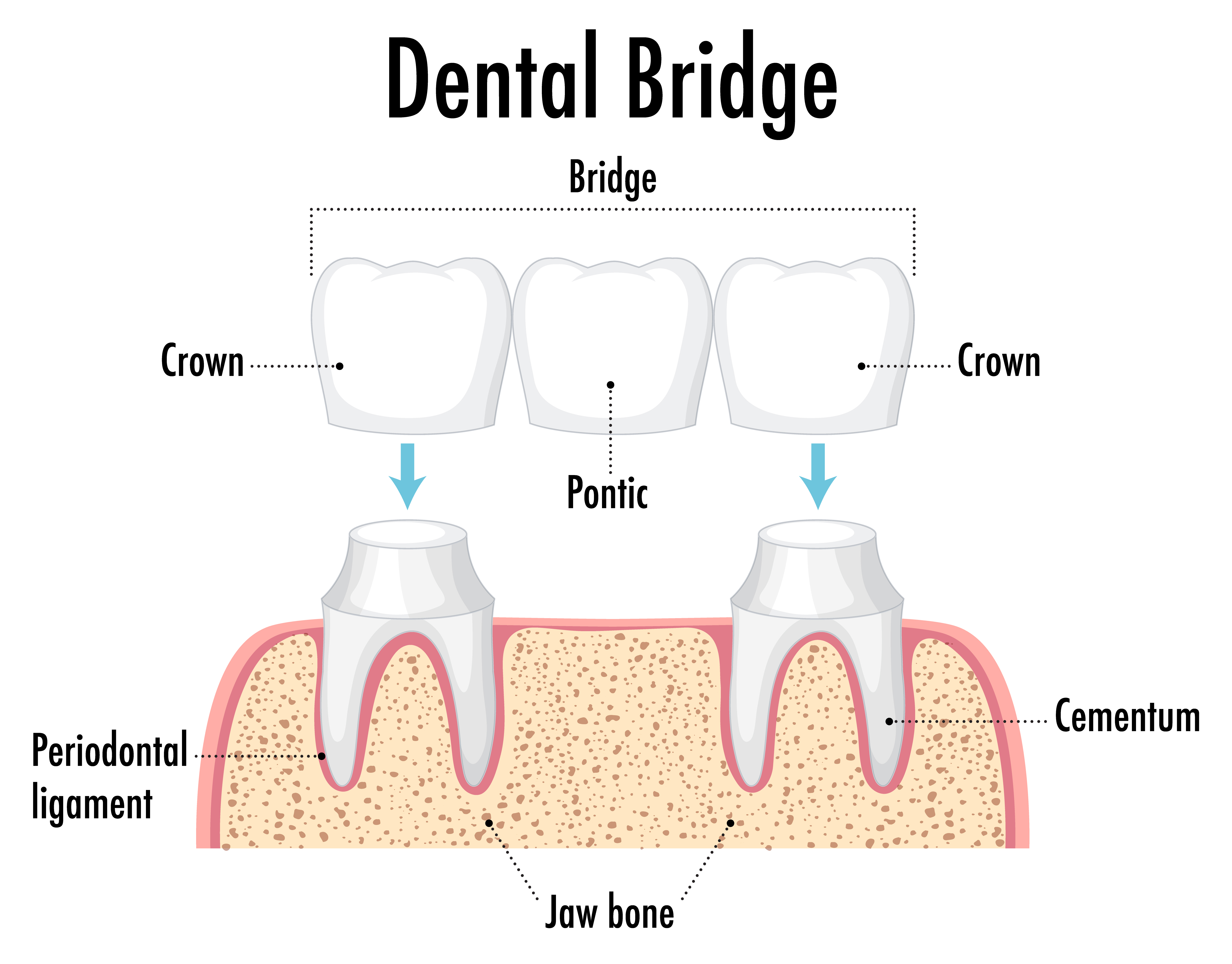
diagram of dental bridge sleep dentistry dr. mahoney

Dental implants

A dental implant serves as a near replica of a real tooth and is anchored into the jawbone. Once properly implemented, it should look and feel like it’s been there all along. However, that implementation process is lengthy and involves two surgeries:

  1. Insertion of titanium screws into the jawbone: The screws will become the replacement tooth’s “roots” or anchor. Over 3-6 months, bone growth around the screws will incorporate the new “roots” within the existing jaw structure (osseointegration).
  2. Connection of mounting posts to the screws: After the jawbone and gum tissue have sufficiently healed from the first procedure, metal posts will be connected to the implanted screws. Artificial teeth will be mounted to these posts.

Dental bridge vs. implant considerations

Given the descriptions above, it may seem like opting for dental implants over dental bridges would be a no-brainer. After all, dental implants help stimulate bone growth (maintaining the jaw and facial structure). They look and feel more natural. They’re also more durable and do not require other (typically healthy) teeth for support. However, one must consider the following:

  • Location: Are the missing teeth in a prominent or visible area of the mouth? How much stress would be put on the replacement tooth mechanically?
  • Time: Osseointegration is critical to the success of any dental implant. Bone healing takes several months. It is not intended to be a quick fix, but more of an investment. Comparatively, dental bridges can be implemented within weeks.
  • Money: It should be no surprise that dental implants are significantly more expensive. Insurances are much less likely to cover them. But with routine care, they can last an entire lifetime. Bridges need replacement every 5-10 years, depending on how well you maintain them (cleaning underneath pontics is a step you don’t have to take with natural teeth). For a lot of folks, dental implants are cost-prohibitive.
  • Overall oral health: What condition are the prospective abutment teeth in? If they’re due for a crown shortly anyway, a bridge makes a lot of sense. 
  • Eligibility: Depending on your age, lifestyle, and general health, you may not be a good candidate for dental implants anyway. Only adults can receive dental implants; children and adolescents are still developing. Smokers must firmly commit to cessation before being approved for surgery. Those with chronic conditions such as diabetes or cancer may need additional treatment, which can further amplify the overall cost. Furthermore, if you’ve had missing teeth for a while, considerable gum and bone recession may have already taken place. Bone grafts may be required.

Tooth restoration with Dr. Kevin Mahoney

Missing out on life’s enjoyments due to missing teeth? Sleep Dentistry with Dr. Kevin Mahoney offers a full range of tooth restoration treatments to help you look and feel as good as new. Don’t delay — schedule your appointment today.

RESTORE MY SMILE