


Teeth Cleaning For Adults and Children in Erie, PA

While the foundation of dental hygiene is your at-home dental care routine, it's just as important to visit the dentist regularly to make sure your teeth are healthy and your smile is bright. Regular teeth cleaning performed by a professional dental hygienist prevents gum disease and tooth decay - which could ultimately lead to the removal of the tooth.

smiling couple

Why Have Professional Teeth Cleaning?

There are several good reasons why you should schedule teeth cleaning every six months, even if you maintain a meticulous dental hygiene regimen at home. 

  1. Dentists and dental hygienists have the tools and expertise to monitor for issues you might not necessarily be able to see or feel.

  2. Professional teeth cleaning instruments are the only thing powerful enough to remove hardened dental plaque, aka calculus or tartar. 

  3. Professional teeth cleaning can make your smile appear whiter and brighter, helping to remove stains, plaque, and tartar. 

  4. It can save you time, money, and suffering down the road — teeth cleanings prevent small problems from becoming major issues, sparing you time in the dentist’s chair undergoing costly procedures.

Teeth Cleaning Procedures

It’s important to set kids up for optimal oral health throughout their growth and development, which is a primary focus of pediatric dentistry and aided by regular teeth cleanings. As we get older as adults, we must treat our teeth with extra special attention and care so that we can enjoy life to the fullest. 

A typical teeth cleaning takes 30-60 minutes and consists of: 

  • Oral health exam (may include x-rays)
  • Removal of tartar and plaque buildup
  • Teeth polishing

Dental anesthesia is also available to patients who have a fear of dentists or simply need extra relaxation during procedures. At Sleep Dentistry Erie, we are committed to helping our patients — with or without insurance — achieve their healthiest smiles.

Schedule Appointment

Frequently Asked Questions

How frequently should I have my teeth cleaned?

You should have your teeth cleaned at least once a year for healthy adults, although a routine dental cleaning and examination every six months is preferable. If you have a chronic medical condition (such as diabetes), take medication (especially those that contribute to xerostomia, or dry mouth), wear braces, are prone to poor dietary (sugary or high-carb snacks between meals) or lifestyle habits (smoking), or simply have a mouth that is smaller and more difficult to clean, it is recommended you get checked up on more regularly.

Should I still get my teeth professionally cleaned even if I regularly brush and floss at home?

Yes, you should still get your teeth professionally cleaned. Even with regular brushing and flossing — and good technique with both — the vast majority of people fail to clear away all the plaque that builds up on and between teeth. Once that hardens into dental calculus or tartar, no amount of brushing or flossing can remove it. Only the specialized tools and equipment of a dental hygienist can loosen, rinse, and suction it away.

Why are my teeth so sensitive after a teeth cleaning?

One reason your teeth are so sensitive after a teeth cleaning is dental cleaning tools making contact with gum surfaces, especially puffy or swollen gums, leading to sensitivity or bleeding. Once teeth have been properly scaled of calculus/tartar, tooth structure that may have not been exposed in “many moons” will be experiencing sensation directly for the first time in a while, it will need time to adjust. Exposed tooth roots near the gumline are especially susceptible to sensitivity. 

How soon can I eat and drink again after having my teeth cleaned?

You can eat and drink immediately after having your teeth cleaned, unless you’ve received a fluoride treatment, which needs at least half an hour to settle and seal around your teeth to maximize its enamel-fortifying benefits. Nonetheless, take care with what you eat or drink after a professional dental cleaning, as your teeth will likely be sensitive to hot, cold, spicy, crunchy, or acidic foods. If you’re thirsty, drink water. If you’re hungry, opt for soft foods served near room temperature.

Will routine dental cleanings whiten my teeth?

Whiter teeth are an ancillary benefit of a routine dental cleaning, but not its goal — for that you may want to invest in our Lifetime Whitening Program.  Nonetheless, after we’re done buffering away tartar (which may take on a yellowish or greenish tinge) and polishing your teeth, they may very well look whiter and brighter than when you walked in!

Where To Find Us 

📍 Address: 3915 Caughey Rd, Erie, PA 16506
 
📞 Phone:  (814) 833-3505
 

Recent Posts

Dental Restoration Types: Direct vs. Indirect

Posted on November 18th, 2020 at 9:53 AM
Dental Restoration Types: Direct vs. Indirect

What is dental restoration?

Your teeth can suffer structural loss for several reasons, whether it’s due to decay or external trauma. Whatever the case may be, direct and indirect dental restorations are treatments that restore the look and integrity of teeth. Both serve the same purpose but do so using different approaches.

Let's explore the different types of dental restorations at length.

Direct dental restorations (fillings)

Direct dental restorations involve stuffing the tooth with a soft filling, which sets and hardens, thereby restoring the teeth. Fillings are most commonly composed of silver amalgam or tooth-colored composite synthetic resin.

The advantage of this type of dental restoration is that it is not very time-consuming. It only takes one visit to the dentist to complete the whole process, and all of the work occurs within the mouth. Whether a filling is a viable restoration option depends on the severity of the tooth decay and its location.

smiling woman autumn

Indirect dental restoration

Indirect dental restorations usually require more than one visit to the dentist and are far more complex than direct dental restorations. The reason they are called “indirect” is that all or part of the restoration may be fabricated in a lab, rather than within the mouth itself.

During the initial visit, impressions are taken and your dentist may complete some initial site prep. Temporary dental restorations may be applied to ensure there are no further damages to the teeth as the more permanent solution is being worked on. Once the dental restoration is done, it is cemented in the patient's mouth using a bonding paste during a follow-up visit.

Thanks to technological advances, indirect restorations can sometimes be completed in a single visit through computer-aided drafting and 3D modeling applications.

Crowns

In situations where the loss of tooth structure is too extensive to be patched with a filling, crowns provide your teeth with a replacement “cap” that is a replica of its original size and shape. Crowns are fused to the intact tooth structure with a powerful bonding agent.

Bridges 

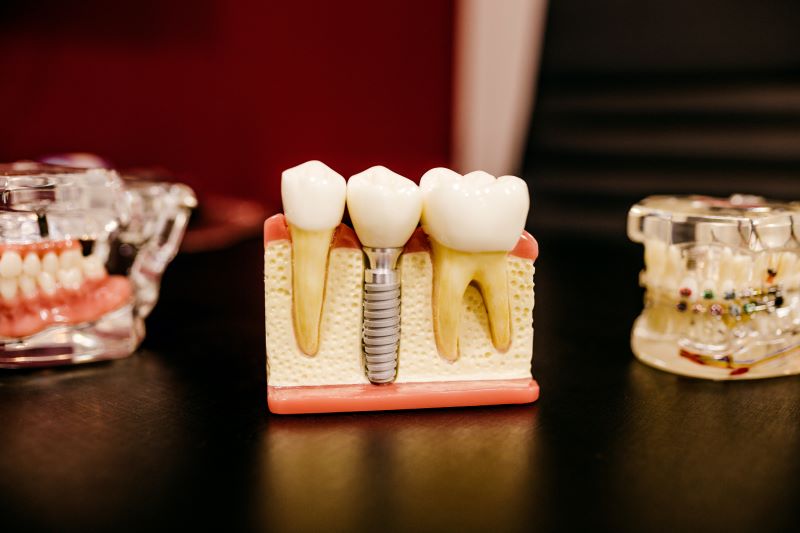
Bridges cover a gap created as a result of one or more missing teeth. They consist of one or more false teeth (pontics) supported by abutments in the form of existing teeth or dental implants.

Implants 

Dental implants are crowns anchored into the jaw bone with a titanium screw. They function essentially like brand-new teeth.

Dentures

Dentures are prosthetic devices and are a combination of acrylic resin and metal attachments. There are two types, complete and partial. An individual can use full dentures when all the teeth are missing. On the other hand, partial or half dentures are used when an individual has some of his natural teeth remaining. 
Which dental restoration type is suitable for me?

Direct restorations happen when the natural teeth of the patient are still healthy and strong enough to remain. However, to make filling possible, a dentist might scrape off some part of it to create room.

On the other hand, indirect restoration is necessary when external trauma or advanced decay has resulted in tooth loss. They involve a man-made dental solution to cover missing or damaged teeth.

In some cases, a patient may require a combination of both direct and indirect restoration treatments.

Preventive Dental Care with Sleep Dentistry Erie

If you haven't gone for a dental checkup for a while, now is the best time to do so! Regular checkups help detect conditions before they escalate, helping to reduce or eliminate the need for dental restorations in the first place. Play for keeps with Dr. Mahoney and his dedicated team of dental professionals! 

REQUEST AN APPOINTMENT