


It’s everyone’s goal to make it through life with a fully intact, healthy smile. Unfortunately, due to physical trauma or periodontal disease, many people lose teeth permanently. Missing teeth don't just affect the look of your smile — they may also impact the ability to properly chew food or speak clearly. If left uncorrected, they may even lead to bone recession and loss in the jaw, ultimately changing the shape and structure of the face.
Clearly, losing one’s adult (permanent) teeth can have pretty serious implications! Thankfully, today’s dental professionals have more and more advanced ways of filling in the gaps with durable and dependable tooth restoration treatments. The most commonly employed are dental bridges and dental implants.
Dental bridges
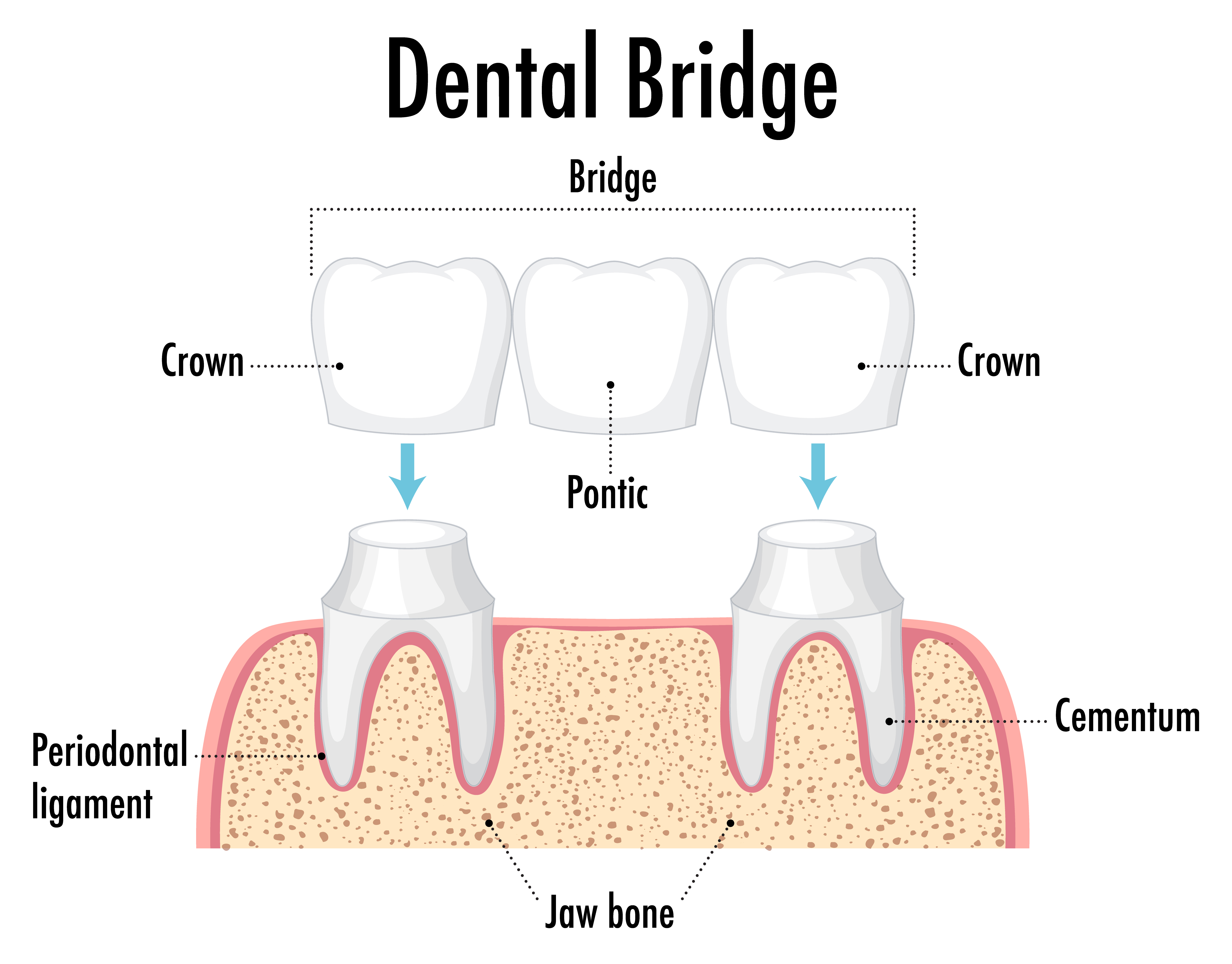
A dental bridge has two main components: abutments (support structures) and pontics (the prosthetic teeth that “bridge” the gap created by the missing teeth).
Either natural teeth or implants (sometimes both) can serve as abutments, depending on how many teeth in a row are missing and whether the existing teeth are healthy enough to support the bridge. The type of bridge is determined by how the false teeth are anchored.
- Traditional dental bridges: The bridge is secured to ceramic or porcelain crowns affixed to natural teeth on either side of the gap. The enamel of the abutment teeth must be shaved down to accommodate the crowns.
- Implant-supported dental bridge: Similar to above, except with dental implants serving as the abutments.
- Cantilever dental bridges: The false tooth is suspended over the gap using only one anchor tooth. They do not hold up well in the back of the mouth, where teeth are designed to crush food and can withstand higher pressure.
- Maryland dental bridge: Metal wings on either side of a porcelain or plastic replacement tooth are bonded to the backs of the abutment teeth. Often employed as a temporary measure while a longer-lasting alternative is worked out.
Dental implants
A dental implant serves as a near replica of a real tooth and is anchored into the jawbone. Once properly implemented, it should look and feel like it’s been there all along. However, that implementation process is lengthy and involves two surgeries:
- Insertion of titanium screws into the jawbone: The screws will become the replacement tooth’s “roots” or anchor. Over 3-6 months, bone growth around the screws will incorporate the new “roots” within the existing jaw structure (osseointegration).
- Connection of mounting posts to the screws: After the jawbone and gum tissue have sufficiently healed from the first procedure, metal posts will be connected to the implanted screws. Artificial teeth will be mounted to these posts.
Dental bridge vs. implant considerations
Given the descriptions above, it may seem like opting for dental implants over dental bridges would be a no-brainer. After all, dental implants help stimulate bone growth (maintaining the jaw and facial structure). They look and feel more natural. They’re also more durable and do not require other (typically healthy) teeth for support. However, one must consider the following:
- Location: Are the missing teeth in a prominent or visible area of the mouth? How much stress would be put on the replacement tooth mechanically?
- Time: Osseointegration is critical to the success of any dental implant. Bone healing takes several months. It is not intended to be a quick fix, but more of an investment. Comparatively, dental bridges can be implemented within weeks.
- Money: It should be no surprise that dental implants are significantly more expensive. Insurances are much less likely to cover them. But with routine care, they can last an entire lifetime. Bridges need replacement every 5-10 years, depending on how well you maintain them (cleaning underneath pontics is a step you don’t have to take with natural teeth). For a lot of folks, dental implants are cost-prohibitive.
- Overall oral health: What condition are the prospective abutment teeth in? If they’re due for a crown shortly anyway, a bridge makes a lot of sense.
- Eligibility: Depending on your age, lifestyle, and general health, you may not be a good candidate for dental implants anyway. Only adults can receive dental implants; children and adolescents are still developing. Smokers must firmly commit to cessation before being approved for surgery. Those with chronic conditions such as diabetes or cancer may need additional treatment, which can further amplify the overall cost. Furthermore, if you’ve had missing teeth for a while, considerable gum and bone recession may have already taken place. Bone grafts may be required.
Tooth restoration with Dr. Kevin Mahoney
Missing out on life’s enjoyments due to missing teeth? Sleep Dentistry with Dr. Kevin Mahoney offers a full range of tooth restoration treatments to help you look and feel as good as new. Don’t delay — schedule your appointment today.