



Orthodontics in Erie, PA

Cosmetic Dental Services in Erie, PA

Unfortunately, many of us aren’t born with the blueprints for a perfect smile. Our permanent teeth may come in misspaced or misaligned, or our jaws may be out of sync or out of proportion with one another. These imperfections often affect more than looks — untreated, they may compromise oral hygiene and dental health. 

Orthodontics is the area of dentistry dedicated to correcting bite issues (malocclusion) to help patients not only look better, but also breathe, chew, speak, and care for their teeth easier.

Orthodontic services we offer

Sleep Dentistry with Dr. Kevin Mahoney is pleased to offer a full complement of orthodontic treatments and appliances in Erie, PA, from traditional metal braces to Invisalign (invisible aligners). No matter how old you are or where you’re at in your mouth’s development, realignment can make a world of difference in function and your quality of life.

When is the best time for braces?

The American Dental Association advises parents to schedule an appointment with a certified orthodontist or a dental professional familiar with orthodontic practice, like Dr. Kevin Mahoney in Erie, PA, by the age of 7. During the initial consultation, bite issues will be assessed and a course of action will be determined. 

Braces are generally worn during a child’s preteens or early teens (ages 10 to 14) because the bones in the head and mouth are rapidly growing and developing during this time, which makes teeth easier to move and straighten. However, it should be noted that 1 in 5 modern orthodontic patients are adults!

Whenever you or a loved one is in line for alignment correction, we are ready to deliver our Erie, PA orthodontic services to you.

Request Appointment

man smiling

Frequently Asked Questions

What is orthodontics?

Orthodontics is a dental specialty that focuses on the diagnosis, prevention, interception, and correction of malocclusion (the imperfect positioning of the teeth), along with neuromuscular and skeletal abnormalities.

What are braces?

Braces are meant to straighten and correct the alignment of your teeth that consist of brackets and wires. Some types of braces include:

  • Clear
  • Ceramic
  • Gold
  • Lingual (behind the Tooth)
  • Self-ligating
  • Metal
  • Invisalign (Braces Alternative)
Does getting braces hurt?

Getting braces usually includes minor aches and pains that occur when they are first put on, and when they are adjusted. These pains are known to only last a short amount of time and leave no lasting effect. If necessary, over-the-counter painkillers can be used to alleviate some of the pain.

Why should I get orthodontic treatment?

There are two main reasons to get orthodontic treatment, the first being aesthetic. Having an attractive smile can enhance your own self-image and also change the way people see you. The second being function. Getting orthodontic treatment can help your teeth develop better, and make them easier to clean, which can improve your overall health.

How often do I need to visit the orthodontist?

Usually, during treatment, patients are to visit every four to six weeks. This allows us to track the progress of your treatment and make any changes if necessary. After braces are removed, it is recommended that you visit your orthodontist every six months for a general check up on how your teeth have adjusted to the changes.

After my braces are removed, how should I care for my retainer?

Caring for your retainer after braces should become a regular activity for you. During meal times, keep your retainer in its protective case provided by your dentist. This will ensure it does not get lost or broken. After eating, brush your teeth thoroughly before putting the retainer back in. At the end of the day, it is important to clean your retainer. Cleaning it with toothpaste is not recommended, but brushing it gently with a toothbrush and antibacterial soap is. Never place your retainer in boiling water or a dishwasher to clean it.

Where To Find Us 

📍 Address: 3915 Caughey Rd, Erie, PA 16506
 
📞 Phone:  (814) 833-3505
 

Recent Posts

Dental Restoration Types: Direct vs. Indirect

Posted on November 18th, 2020 at 9:53 AM
Dental Restoration Types: Direct vs. Indirect

What is dental restoration?

Your teeth can suffer structural loss for several reasons, whether it’s due to decay or external trauma. Whatever the case may be, direct and indirect dental restorations are treatments that restore the look and integrity of teeth. Both serve the same purpose but do so using different approaches.

Let's explore the different types of dental restorations at length.

Direct dental restorations (fillings)

Direct dental restorations involve stuffing the tooth with a soft filling, which sets and hardens, thereby restoring the teeth. Fillings are most commonly composed of silver amalgam or tooth-colored composite synthetic resin.

The advantage of this type of dental restoration is that it is not very time-consuming. It only takes one visit to the dentist to complete the whole process, and all of the work occurs within the mouth. Whether a filling is a viable restoration option depends on the severity of the tooth decay and its location.

smiling woman autumn

Indirect dental restoration

Indirect dental restorations usually require more than one visit to the dentist and are far more complex than direct dental restorations. The reason they are called “indirect” is that all or part of the restoration may be fabricated in a lab, rather than within the mouth itself.

During the initial visit, impressions are taken and your dentist may complete some initial site prep. Temporary dental restorations may be applied to ensure there are no further damages to the teeth as the more permanent solution is being worked on. Once the dental restoration is done, it is cemented in the patient's mouth using a bonding paste during a follow-up visit.

Thanks to technological advances, indirect restorations can sometimes be completed in a single visit through computer-aided drafting and 3D modeling applications.

Crowns

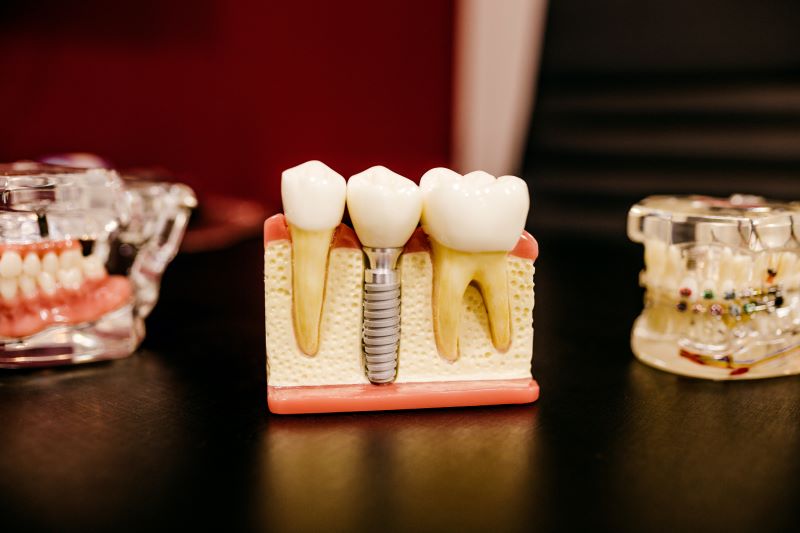
In situations where the loss of tooth structure is too extensive to be patched with a filling, crowns provide your teeth with a replacement “cap” that is a replica of its original size and shape. Crowns are fused to the intact tooth structure with a powerful bonding agent.

Bridges 

Bridges cover a gap created as a result of one or more missing teeth. They consist of one or more false teeth (pontics) supported by abutments in the form of existing teeth or dental implants.

Implants 

Dental implants are crowns anchored into the jaw bone with a titanium screw. They function essentially like brand-new teeth.

Dentures

Dentures are prosthetic devices and are a combination of acrylic resin and metal attachments. There are two types, complete and partial. An individual can use full dentures when all the teeth are missing. On the other hand, partial or half dentures are used when an individual has some of his natural teeth remaining. 
Which dental restoration type is suitable for me?

Direct restorations happen when the natural teeth of the patient are still healthy and strong enough to remain. However, to make filling possible, a dentist might scrape off some part of it to create room.

On the other hand, indirect restoration is necessary when external trauma or advanced decay has resulted in tooth loss. They involve a man-made dental solution to cover missing or damaged teeth.

In some cases, a patient may require a combination of both direct and indirect restoration treatments.

Preventive Dental Care with Sleep Dentistry Erie

If you haven't gone for a dental checkup for a while, now is the best time to do so! Regular checkups help detect conditions before they escalate, helping to reduce or eliminate the need for dental restorations in the first place. Play for keeps with Dr. Mahoney and his dedicated team of dental professionals! 

REQUEST AN APPOINTMENT